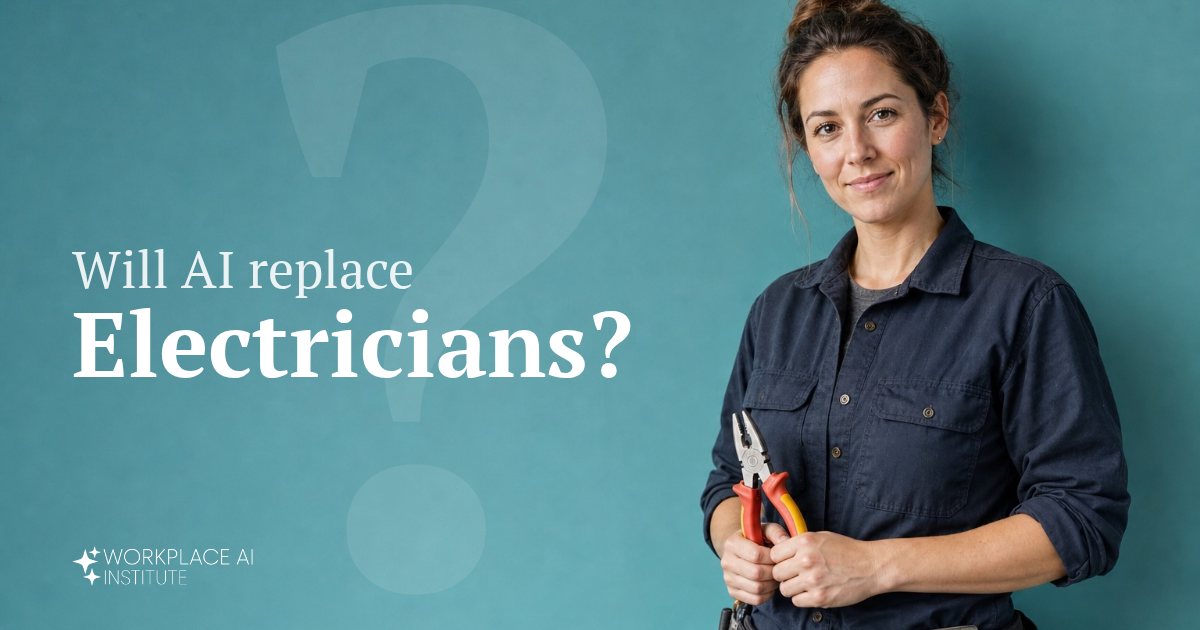
Will AI Replace Electricians?
Solar arrays, EV chargers and grid upgrades need hands on site, and demand is climbing.
Published
Chance this role is fully replaced by AI in the next 10 years.
The Short Answer
No. The Bureau of Labor Statistics (BLS) projects electricians to grow about 9% through 2034, much faster than the average job, because someone has to wire the solar arrays, the EV chargers, and the grid upgrades, and none of that happens from a laptop. What AI changes is the business behind the tool belt, the quoting, scheduling, and customer follow-up that decides which shop wins the work.
How future-proof is your electrical business against AI?
A 60-second personalised assessment. No email required to see your result.
Take the assessment →A customer watched a thirty-second video of someone asking ChatGPT how to wire a three-way switch, and now they’re standing in their kitchen asking why your quote costs what it costs.
You’ve had some version of that conversation more than once this year.
Maybe an apprentice asked whether the trade is still worth getting into. Maybe a headline about AI doing skilled work caught you for a second and made you wonder if it meant you too.
So here is the short version before anything else. Nobody is sending a robot into a crawlspace to chase a dead circuit. The trade is safe. The business around the trade is changing quickly, though, and that part is worth ten minutes of your time.
The trade itself is one of the safest jobs there is
The Bureau of Labor Statistics (BLS) projects employment of electricians to grow about 9% from 2024 to 2034, much faster than the average for all occupations, with roughly 81,000 openings every year over the decade.
That growth has a cause. Someone has to wire the solar arrays, the battery storage, the EV chargers, and the grid upgrades, and that work happens on a ladder and inside a panel, not on a screen.
An AI can describe how to land a feeder. It cannot land one. It cannot find the open neutral hiding behind the drywall, and it cannot be the licensed name an inspector signs off against.
That is the part of this no software touches, and it is most of the job.
What AI cannot do on a job site
Strip the work down and three things stay firmly in human hands.
The physical work is the obvious one. Pulling and terminating, fishing wire through a finished wall, troubleshooting a circuit that worked yesterday and doesn’t today. A model that has read every electrical textbook ever written still cannot hold a pair of strippers.
Then there is the license and the liability. When the work is signed off, it is signed off against a qualified human who carries the responsibility if something is wrong. That accountability does not transfer to a chatbot, and no homeowner’s insurer would accept it if it tried to.
And there is being there. The 11pm call when the power is out, the read on whether a forty-year-old install is safe to touch, the instinct that only comes from having seen it go wrong before.
Across the occupations the Workplace AI Institute tracks, the skilled trades sit in the safest tier we see, because hands-on, licensed, on-site work is close to the hardest thing there is for AI to take.
Where AI actually changes the trade
Here is the part that does matter, and it has nothing to do with a robot.
The competition in your area is not man against machine. It is the shop drowning in paperwork against the shop that gets quotes out the same day. Same skills, same gear, very different businesses.
Think about where your own time leaks. Estimates written at the kitchen table at 9pm. The follow-up text to last week’s quote that you never sent. The Google listing you set up once and forgot about. Every one of those is now something AI can draft in minutes while you stay on the tools.
Talk to enough electricians and the pattern is hard to miss. The next few years sort the trade less by skill than by how well the office runs. The work was never the bottleneck. The paperwork is.
Here is where it bites in practice. A customer pushes back on a quote, and instead of a defensive phone call, you send something like this.
Write a short, friendly text I can send a customer who thinks my quote is too high. The job is [BRIEF DESCRIPTION OF THE JOB]. Explain in plain language what they’re paying for, why doing it to code matters for their safety, and what could go wrong if it’s done on the cheap. Keep it under 120 words and don’t talk down to them.
Read it, fix the one detail it got slightly wrong, send it. Two minutes, and the customer feels respected instead of squeezed.
You can probably guess which kind of shop you run. The 3-minute readiness check confirms it, walking the admin side of your business and flagging where the time leaks out.
The three moves that win you the next job
The trade is safe. The market share is not. Three moves decide who takes it.
- Get your quotes out the same day. The estimate that lands while the customer is still deciding wins more often than the better-priced one that turns up next week. Draft it from your job notes, check it, send it.
- Never let a lead go cold. Most jobs are lost to silence, not to price. A short follow-up sequence, written once and reused, keeps warm customers from drifting to whoever called them back first.
- Show the work online. Photos of clean panels, a handful of honest reviews, a Google listing that actually describes what you do. This is how you stop competing on price and start competing on reputation.
If you want the step-by-step version of all three, the AI for Electricians course is built around exactly this, from estimates and invoices through to client messages and local marketing.
So will AI replace electricians?
No. The demand is climbing and the work is some of the hardest in the economy to automate.
What AI does is quietly raise the bar on the business side. The electrician who still runs the office like it’s 1995 will keep doing fine work and keep losing jobs to the one whose quote arrived first.
What we keep seeing is that the office, not the panel, is where this decade’s jobs get won and lost.
Not sure whether the paperwork is quietly costing you jobs? The readiness check is built to find exactly that.
You already own the part that’s hard to replace. The move now is to make the easy part, the paperwork, stop costing you work.
What AI does well
What stays with you
Draft estimates and proposals
Feed AI the job details and it writes a clear scope and a clean estimate in minutes, so quotes go out the same day instead of piling up for the weekend.
Do the physical work
Pulling wire, diagnosing a dead circuit inside a finished wall, terminating a panel, and getting it right in a tight crawlspace. None of that goes to a screen.
Handle customer messages and follow-ups
AI drafts the quote follow-up, the appointment reminder, and the plain-language explainer for why a job costs what it does, in your voice.
Carry the license and the liability
An inspector signs off on a licensed human, not a chatbot. The legal responsibility for safe work stays with you.
Look things up and write the boring paperwork
Code references, change orders, warranty documents, safety toolbox talks, and Google Business copy that used to eat your evenings.
Show up when it matters
The 11pm no-power call, the read on whether an old install is safe to touch, the judgment that comes from a thousand jobs. AI has none of it.
Stay Ahead of AI with a Verified Certificate
The people who come out ahead are the ones who can show they use AI well on the work that matters. The AI for Electricians course teaches it on the tasks of your own job, ends with an exam, and gives you a certificate an employer can check by its ID.
- Final exam with a 70% pass mark
- Unique certificate ID, verifiable online
- About 25 hours, self-paced
- 30-day money-back guarantee
AI for Electricians Course
Every lesson, prompt, and exercise in this course is built around the actual work electricians do every day. No coding. No jargon. Just practical skills you can use this week.