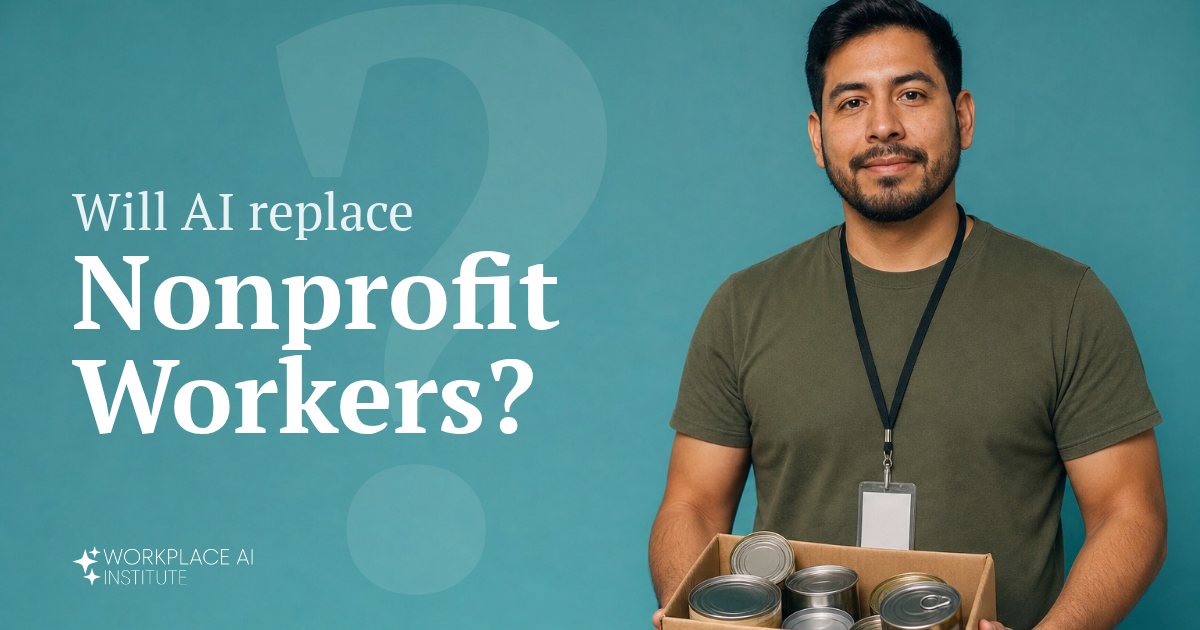
Will AI Replace Nonprofit Workers?
Sitting with the people you serve is not something a model does, though it can clear your inbox.
Published
Chance this role is fully replaced by AI in the next 10 years.
The Short Answer
No. The work that defines a nonprofit, sitting with the person you serve, showing up in the community, advocating for a cause, is not something a model does. The jobs the Bureau of Labor Statistics (BLS) tracks closest to nonprofit work are projected to grow about 6% through 2034, faster than average. What AI absorbs is the back-office layer, the reporting, the grant admin, the data entry and the scheduling, and on a tiny budget that is not a threat so much as hours handed back to the mission.
How exposed is your career as a Nonprofit Worker to AI?
A 60-second personalised assessment. No email required to see your result.
Take the assessment →A colleague at another organization called you last week, half rattled, half hopeful. Her director had walked into the all-staff meeting with a printout, some piece about a chatbot that could now “run a charity end to end,” and asked the room what that meant for next year’s headcount.
She wanted to know if you were seeing the same thing. You were, sort of. Not the same meeting, but the same uneasy current under it. Every nonprofit you know runs on too little money and too few people, and a board that hears the word efficiency starts doing math you do not want it doing.
So after the call you sat with it. The work itself, the part that drew you in, has never once happened on a screen. The part stacked around it might be another story.
The mission is yours, the paperwork is what is moving
The jobs the Bureau of Labor Statistics (BLS) tracks closest to nonprofit work, social and community service managers, are projected to grow about 6% from 2024 to 2034, faster than the average across all occupations, with roughly 18,600 openings a year. Demand holds because the need does, and someone has to meet it. So the field is not contracting. What moves is the texture of a week.
Walk back through your own. The frontline work you signed up for, and then the silt around it. A funder report due Friday. An intake spreadsheet nobody has touched in a month. The newsletter. The volunteer reminders. The board packet you wrestle into shape the night before. Drafting that layer is the thing AI got fast at.
Read your colleague’s panic against that and it flips. On a budget with no slack and no overtime, a tool that drafts the reporting and tidies the data is the closest thing to a second pair of hands your organization can afford, and it works for nothing. The bottleneck was never how much your people care. It was always how many of them there are against how many forms the day demands, and we keep meeting program staff who only realize that once the forms move off their plate.
Few program staff have ever added up what those forms cost, because no one logs the funder report you finished on a Sunday. A 3-minute readiness check does the tally, splitting the reporting and data work a tool can now shoulder from the frontline hours only you can give, so the trade-off your director is guessing at becomes plain numbers.
What AI cannot do where the mission actually happens
No efficiency printout grasps this part. The work that makes your organization what it is happens in one room with one person, and that room does not fold down to a faster version.
A model can write up the family you helped. It cannot sit beside them, read whether a client is safe to send home, steady a session that has gone sideways, earn the trust a neighborhood extends one honest interaction at a time, or stand in a council chamber and argue the case that bends a policy. Frontline service, in-person advocacy, community trust, the judgment a delicate case demands, none of it lives in an algorithm.
What strikes us, talking to teams across the sector, is that the ones most relaxed about AI are not automating their mission at all. They are automating the forms, precisely so the mission keeps more of them.
What working with AI actually looks like for a nonprofit worker
Skip the abstractions and watch one task you dread, the quarterly funder report, start to finish.
It is Wednesday, the report is due Friday, and you have a stack of program numbers, a folder of session notes, and last quarter’s template. The old version is three stolen evenings. The version with a tool in the loop opens with you pasting all of it in.
I run a [PROGRAM TYPE] serving [WHO YOU SERVE]. Here are this quarter’s numbers and my session notes. [PASTE NUMBERS AND NOTES]. Draft a 500-word funder report with an outcomes summary up top, two impact-story slots left blank for me to fill with accurate detail, and a plain-language section on what we learned and what we would change. Flag every figure you are not certain about so I can verify it against my records before this leaves my hands.
Two minutes later you have a structured draft, the outcomes in order, the learnings section shaped, and a short list of numbers the tool wants you to double-check.
Now the part the draft cannot do begins. You pull the actual figures, correct the two it guessed at, and write the impact stories yourself, because you were in the room and it was not. The draft handled the scaffolding, the truth and the judgment are still yours.
Friday morning, the report goes out, and the two evenings it would have eaten went back to the program instead. Run the same loop on the case-note cleanup and the monthly newsletter and the pattern holds, the tool carries the structure, you carry the substance.
Where the reclaimed hours go over the next year
The skills your work demands are shifting under everyone, not only in nonprofits. The World Economic Forum (WEF) estimates around 40% of the skills workers rely on will change by 2030, so the question is not whether your week reshapes but who decides how. Here is one way the year can run if you decide.
This week, you pick the single form that robs you of the most evenings and hand its first draft to a tool every time it comes due, nothing fancier than that one habit.
By next month the draft-and-verify loop is reflex, and the two or three hours it returns each week land in the same slot every time.
By the quarter’s end you have named where those hours go before they arrive, the after-school room, an extra home visit, the program you could never quite staff, so the time does not refill with more admin.
By this time next year you and one teammate both work this way, and a two-person team running lean has the capacity of something closer to three. The budget did not grow. The hours did.
So will AI replace nonprofit workers?
No. The mission work is about as hard to hand to a machine as work gets, and demand for it keeps climbing.
The fair read is neither “nothing changes” nor “the sector is doomed.” The paperwork moves to AI whether you steer it or not, and the people steering it now are the ones turning thin budgets into more hours on the ground.
So when your colleague calls again, you will have an answer better than reassurance. Separate the forms from the frontline, and decide which hours you want a tool to carry and which you would never hand over. The readiness check gives you that split, so you get to choose what the freed time is for instead of letting a board printout choose for you.
The AI for Nonprofit Workers course collects the funder-report, data-cleanup, and volunteer-comms prompts and sequences the capacity-back workflow.
You hold the part that matters most and resists replacement hardest. What is left is to stop letting the forms take the hours that belong to the people you serve.
What AI does well
What stays with you
Draft grant and impact reports
Feed AI your program numbers and notes and it produces a structured first pass at the funder report or the impact summary, so the writing stops eating the evenings you should spend on the work.
Deliver the frontline service the mission exists for
Sitting with someone in crisis, running the after-school room, staffing the food line, being present in a moment that needs a human. That is the work, and no model does it.
Program data entry and admin
Cleaning intake spreadsheets, tagging case notes, formatting the board packet, and the routine document handling that quietly consumes a program coordinator's week.
Build community trust and advocate in person
The trust a neighborhood places in your organization is earned face to face over years, and the advocacy that changes a policy happens in rooms where a person has to speak.
Routine communications and scheduling
Volunteer reminders, newsletter copy, event logistics emails, and the calendar coordination that keeps a small team running.
Make the judgment call in a sensitive situation
Reading a client's safety, knowing when to bend a rule for a person and when not to, and the discretion a hard case demands. That judgment stays human.
Stay Ahead of AI with a Verified Certificate
The people who come out ahead are the ones who can show they use AI well on the work that matters. The AI for Nonprofit Workers course teaches it on the tasks of your own job, ends with an exam, and gives you a certificate an employer can check by its ID.
- Final exam with a 70% pass mark
- Unique certificate ID, verifiable online
- About 25 hours, self-paced
- 30-day money-back guarantee
More from Nonprofit, Community & Faith
AI for Nonprofit Workers Course
Every lesson, prompt, and exercise in this course is built around the actual work nonprofit workers do every day. No coding. No jargon. Just practical skills you can use this week.