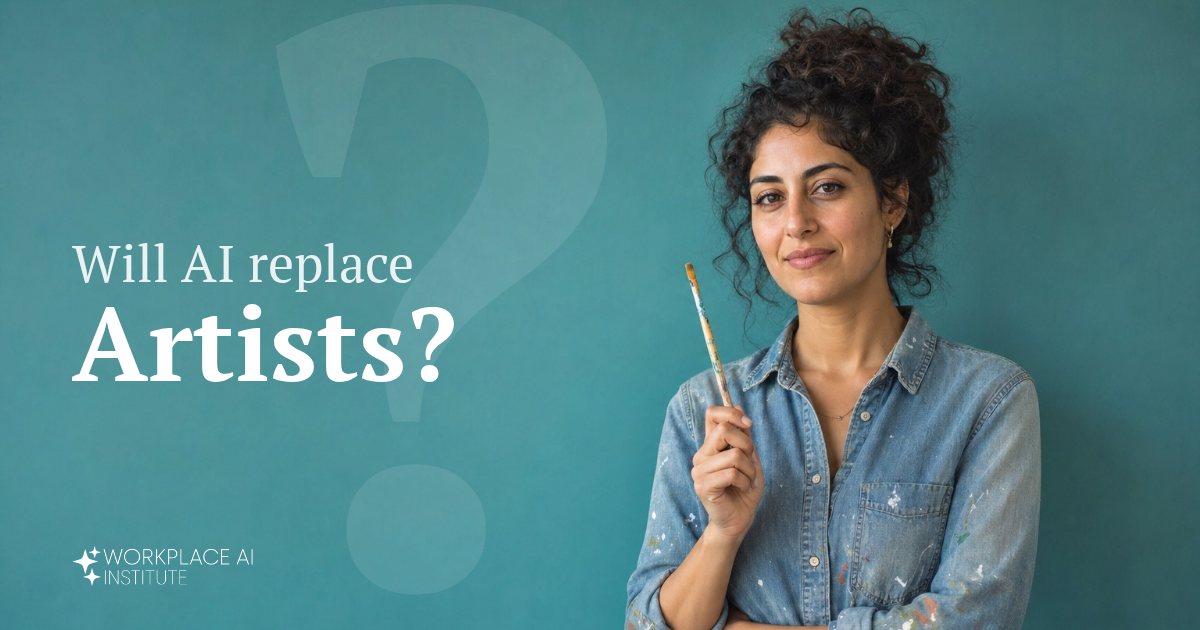
Will AI Replace Artists?
Stock-style images are going to AI. Work tied to your name and your hand is holding its value.
Published
Chance this role is fully replaced by AI in the next 10 years.
The Short Answer
Yes for commodity, stock-style image work, and no for art where you, your name, and the physical piece are the point. The Bureau of Labor Statistics (BLS) projects little or no change for craft and fine artists through 2034, and the work holding its value is the work tied to a specific artist and a specific audience, not a generic image anyone could prompt in ten seconds.
How exposed is your work as an Artist to AI?
A 60-second personalised assessment. No email required to see your result.
Take the assessment →You were scrolling on the couch when you saw it. A piece that looked like something you’d have spent a week on and charged for, posted by someone who typed a sentence into a generator and got it back in ten seconds. Maybe a client told you they “just made it themselves” this time. You closed the app and sat with that feeling for a while.
That feeling is why you searched this. So let’s be straight with each other instead of pretending it’s fine or pretending it’s over.
There’s a sharper answer than the doom posts and the people insisting nothing has changed. The art market is splitting into two pieces that are moving in opposite directions, and which side you land on is mostly a set of choices you can start making this week.
Two art economies are pulling apart
The plain read is that generative image tools have already absorbed the commodity end of visual work. Stock-style imagery, generic spot illustration, quick concept passes, the kind of small commercial job where the client only ever wanted “an image that does this thing.” When the buyer doesn’t care whose hand made it, a generator wins on price and speed every time, and that part of the market is not coming back.
The other end is moving the opposite way. Work that people want because you made it is getting more valuable as generic images get cheaper. A physical original with your name on it. A commission where the client wants your specific voice. Art that carries meaning, context, and a relationship with the people who collect it.
The Bureau of Labor Statistics projects little or no change for craft and fine artists through 2034, a quieter number than the headlines suggest. The category isn’t collapsing. It’s separating, and the separation is happening on a clock.
The artists who bring their practice to the Workplace AI Institute and stay steadiest aren’t the ones generating work with AI or the ones refusing to look at it. They’re the ones who moved their energy toward the part of the practice that’s unmistakably theirs.
Not sure which side of that split your practice sits on? The 3-minute readiness check runs the analysis on your own work and hands back a profile.
What AI cannot do, and probably never will
There’s a hard floor under human work, and for artists it’s higher than for almost anyone.
A generator can imitate a style, but it cannot want to say anything. It produces an image; it does not hold the intent, the context, or the reason a piece exists. It cannot make an object that’s singular and signed, with a history that’s part of why someone pays for it. And as images get infinitely cheap, the scarce skill becomes taste, knowing which of a thousand options is worth finishing and why.
There’s also a legal floor that almost nobody talks about. The US Copyright Office has held that images generated purely by an AI from a text prompt can’t be registered, because copyright requires human authorship. Your hand-made work is protectable in a way a prompt output simply is not, and for anyone licensing or selling, that gap is worth money.
The part most artists miss while they’re worried is this. The flood of cheap images doesn’t lower the value of human authorship; it raises it, because authorship is now the scarce thing.
What working with AI actually looks like for an artist
Here’s where people get it wrong. Using AI well as an artist mostly has nothing to do with generating art. It has to do with killing the admin that steals your studio time.
The average working artist loses a startling share of the week to writing that isn’t art. Statements for every application, grant narratives, residency proposals, captions, newsletters, listing descriptions, pricing emails, collector follow-ups. That writing is repetitive and pattern-shaped, which is exactly what AI is good at.
Save this for the next time you finish a piece.
I’m an artist who just finished a new work. My rough notes: [MEDIUM, SIZE, TITLE, WHAT IT’S ABOUT, WHAT SPARKED IT, ANYTHING UNUSUAL ABOUT HOW YOU MADE IT]. Write me a week of social posts about it. One on the process, one on the idea behind it, one short caption for the finished shot, and one that gently invites commission enquiries. Keep my voice plain and warm. No hashtag stuffing, no art-speak.
That’s an evening of caption-staring turned into ten minutes of editing. Do the same for your artist statement, your next grant, your shop listings. If you’d like a clean way to get all of it off your plate, the AI for Artists course walks through the statements, applications, and marketing workflows end to end, and it never asks you to generate a single piece of art.
Three moves that put you on the right side
The commodity squeeze is going to keep going, so the answer isn’t to compete with a generator on price. It’s to become more of what a generator can’t be.
- Make your name the product. Lean into the work that’s about you, your story, your physical pieces, your relationship with the people who buy. Sign things. Tell the story behind the work. Build the audience that wants you, not just an image.
- Get the admin off your plate. Use AI for statements, grants, listings, and marketing so the hours go back to the studio. The artists getting ahead aren’t working more, they’re spending less of the week on paperwork.
- Use AI on your own terms. Decide where it helps you, whether that’s drafting your statement, brainstorming a show title, or building a reference board for your own eyes, and decide where it stays out. Being fluent enough to set those lines yourself beats being blindsided by a client who isn’t.
We’d back the artists who stop treating AI as a threat to outrun and start treating the business side as a chore to automate. That single reframe gives most artists back a day a week.
So will AI replace artists?
The commodity floor is washing out, and the part of the market that’s about a person is rising to meet it.
The clear-eyed answer isn’t “you’re safe” and it isn’t “you’re finished.” It’s that the split is happening now, and the artists doing the deliberate work to move toward the human end, while quietly automating the paperwork, are the ones the next few years reward.
To ground this in your own practice rather than the headlines, the readiness check renders it as a profile worth acting on.
You didn’t become an artist to win a race against a generator. You became one to make work that means something. The good news buried in all the noise is that this is the exact moment that work gets more valuable, not less.
What AI does well
What stays with you
Generate commodity and stock-style images
Text-to-image tools produce generic spot illustration, stock-style imagery, and rough concept passes in seconds for almost nothing. Work that was only ever "an image that does a job" is going first.
Make work that carries your name
A piece a collector wants because you made it, with your story and your hand behind it, is not something a prompt reproduces.
Spin out endless variations and references
Mood boards, reference sheets, and dozens of composition options are a prompt away now, which compresses the early exploration phase that artists used to bill for.
Decide what is actually good
Taste and judgment, knowing which of a thousand options is worth finishing, becomes the scarce skill exactly as images get infinitely cheap.
Handle basic production work
Upscaling, background removal, simple retouching, and format conversion are increasingly automated and no longer a paid step.
Create a physical original with provenance
An object with a history, signed and singular, holds value because it is not infinitely reproducible. That is the opposite of what a generator makes.
Hold the meaning behind the work
Intent, context, and the reason a piece exists are human. AI can imitate a style, but it cannot want to say anything.
Stay Ahead of AI with a Verified Certificate
The people who come out ahead are the ones who can show they use AI well on the work that matters. The AI for Artists course teaches it on the tasks of your own job, ends with an exam, and gives you a certificate an employer can check by its ID.
- Final exam with a 70% pass mark
- Unique certificate ID, verifiable online
- About 25 hours, self-paced
- 30-day money-back guarantee
More from Media, Writing & Communications
AI for Artists Course
Every lesson, prompt, and exercise in this course is built around the actual work artists do every day. No coding. No jargon. Just practical skills you can use this week.